AI product photography that doesn't look like AI
Most AI product photography looks fake for a specific, fixable reason: the model is allowed to regenerate the product, not just the scene around it. Here's the actual discipline behind doing it properly.
 Rebeka SziliCo-founder6 min read
The skepticism about "AI photos" is justified. Most of them look fake — plasticky skin, a burger that isn't quite the burger on the menu, a logo that's warped into something close but wrong. People have learned to spot it, and they're right to be suspicious. The problem isn't that AI image generation is bad at this. It's that most of it is used badly.
Why most AI product photos look fake
The common failure is simple: the model is allowed to regenerate the product itself, not just the world around it. Ask a generic tool for "a nicer photo of this burger" and it will happily invent a different burger — the right idea, the wrong bun, a sesame pattern that doesn't exist, sauce dripping somewhere it wouldn't. It looks like food. It doesn't look like your food. That's the gap people are actually reacting to when they say an AI photo "looks off" — not the lighting, the identity.
What we actually hold constant
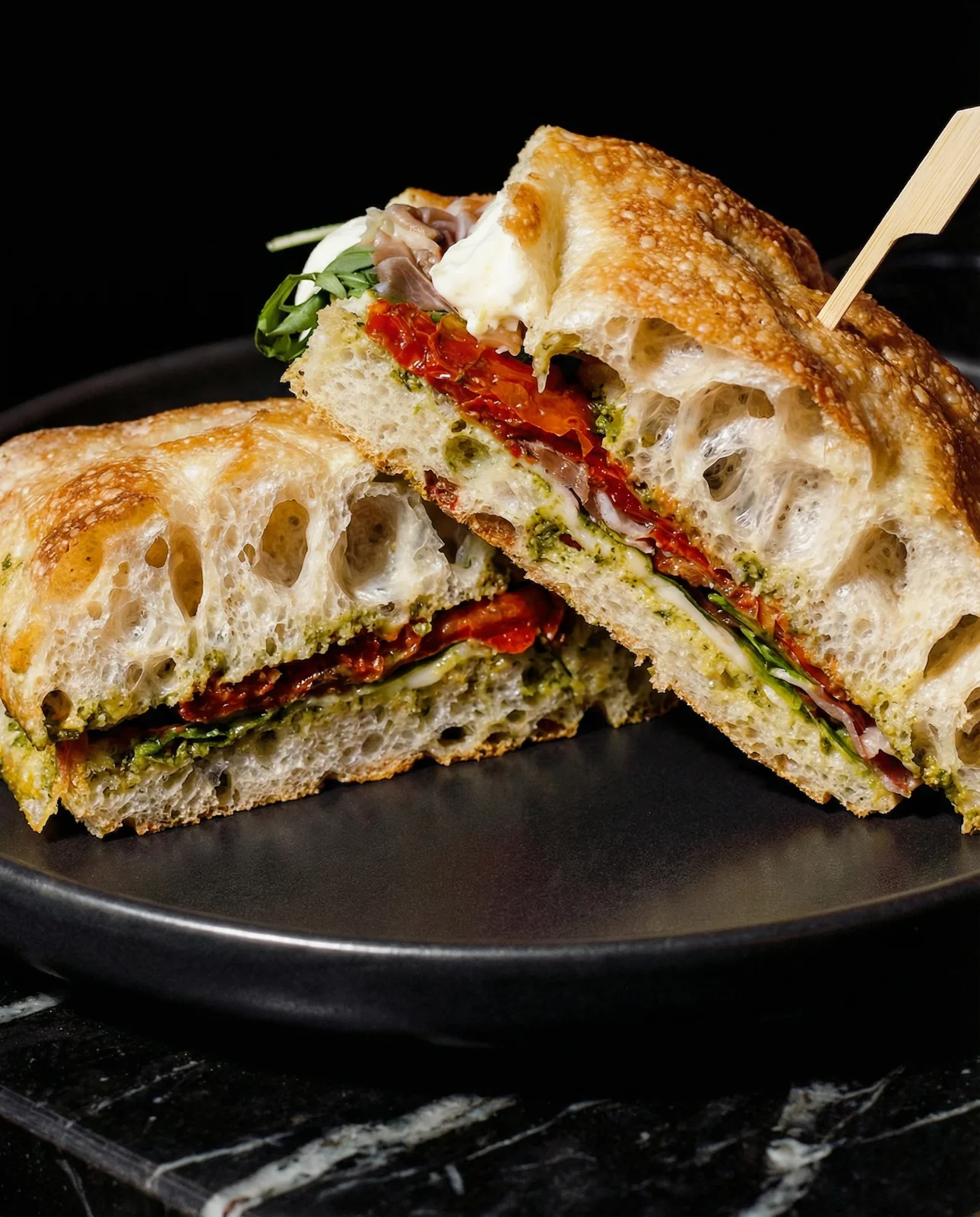
Our rule is the opposite of that default: the product stays true — same plating, same label, same stitching — and only the world around it changes. A phone photo of a focaccia sandwich from a café in Zagreb is enough to start with. We direct the shot like a real one would be directed — backdrop, light, lens and mood, matched to the brand rather than pulled from a template — and the generation step rebuilds everything except the thing being sold. The sandwich that walks out the kitchen door and the sandwich in the hero shot have to be the same sandwich, or the whole exercise has failed regardless of how good the lighting looks.
That's a narrower, harder problem than "make a nice photo," and it's the actual craft. Direction is doing almost all of the work here — the model is closer to a commodity than people assume. Two people can use the identical generation tool and get a convincing hero shot from one and a slightly-wrong uncanny one from the other, because the difference was never the model. It was whether someone who understands food photography, product shots and brand direction was steering it.
Mia is the same discipline, a harder consistency problem
Mia is our in-house AI influencer — a face, a voice and a wardrobe we direct like talent, not a single generated image. The product-fidelity problem from a hero shot becomes a continuity problem here: Mia has to look like the same person across a hundred posts, not just convincing in one frame. The same underlying discipline applies — consistent direction beats a better model — just stretched across time instead of a single photo.
What this actually means if you run a small business
A phone photo is genuinely enough input, as long as the shot itself is clean — the plate, the bottle, the shirt on a hanger, nothing more technical than what you'd already send a friend. From there, delivery happens in every format you actually need — menu, web shop, feed and story — usually within a few days, not the week-plus a real studio shoot and retouch cycle would cost. The honest pitch isn't "AI replaces your product." It's that we finish the photo around a product that was never in question to begin with.
The lesson, if you're evaluating any AI content vendor
Ask what stays fixed, not what the tool can generate. Every generator can produce something plausible. The ones worth paying for are the ones that treat your actual product as the one thing that's never allowed to drift — everything else is staging.
The service behind this post
AI Content Studio
Questions worth answering directly
- Does AI product photography actually keep my product accurate, or does it just generate something similar?
- Done properly, the product itself — the plating, the label, the stitching — is held fixed, and only the backdrop, lighting and framing around it change. Done badly, which is most of what gives AI photography its reputation, the model is allowed to regenerate the product too, which is exactly how you end up with a burger that isn't quite your burger. The question worth asking any vendor is what they hold constant, not what they can generate.
- Is a phone photo actually good enough to start an AI photoshoot from?
- Yes, as long as the shot itself is clean and the product is clearly visible — the same bar as a photo you'd send a friend, not a technical requirement. The art direction and lighting are rebuilt entirely in the next step; the phone photo's job is just to show the model, accurately, what the real product looks like.
- What's the difference between Kyro's AI content studio and Mia, the AI influencer?
- The content studio finishes real product photos — a dish, a drink, a piece of apparel — around a product that has to stay recognizably itself in a single frame. Mia is a fully synthetic in-house influencer we direct like talent across many posts, where the hard problem isn't one convincing photo but staying visibly the same person — same face, same voice, same wardrobe sense — across a hundred of them.
Also available in Hrvatski · Magyar
Rebeka Szili
Co-founder
Your point of contact from first call to launch, and the person who keeps projects moving once the building starts.
Connect on LinkedInHave a project in mind?
More from the Blog
Growth
Reading a Search Console Links report without panicking
A sudden list of unfamiliar domains linking to your site looks alarming in Google Search Console. Most of the time it isn't — but you do need to be able to explain every one of them. Here's how we actually read that report.
Oct 20, 2026 · 6 min read
Engineering
Ady Endre: a CMS built to outlast us
Zagreb's oldest Hungarian cultural society needed its 94-year archive online, in three languages — and a system its own volunteer staff could run without us. This is our one real client project, and the three technical calls that mattered most.
Oct 18, 2026 · 7 min read
Case notes
Rotyi Bistro: a menu that gets out of its own way
Small kitchens live on Instagram, but their websites are often a PDF nobody opens. We wanted to see what happens when the website works as hard as the Instagram feed does.
Oct 16, 2026 · 5 min read